 Sternwheeler.org
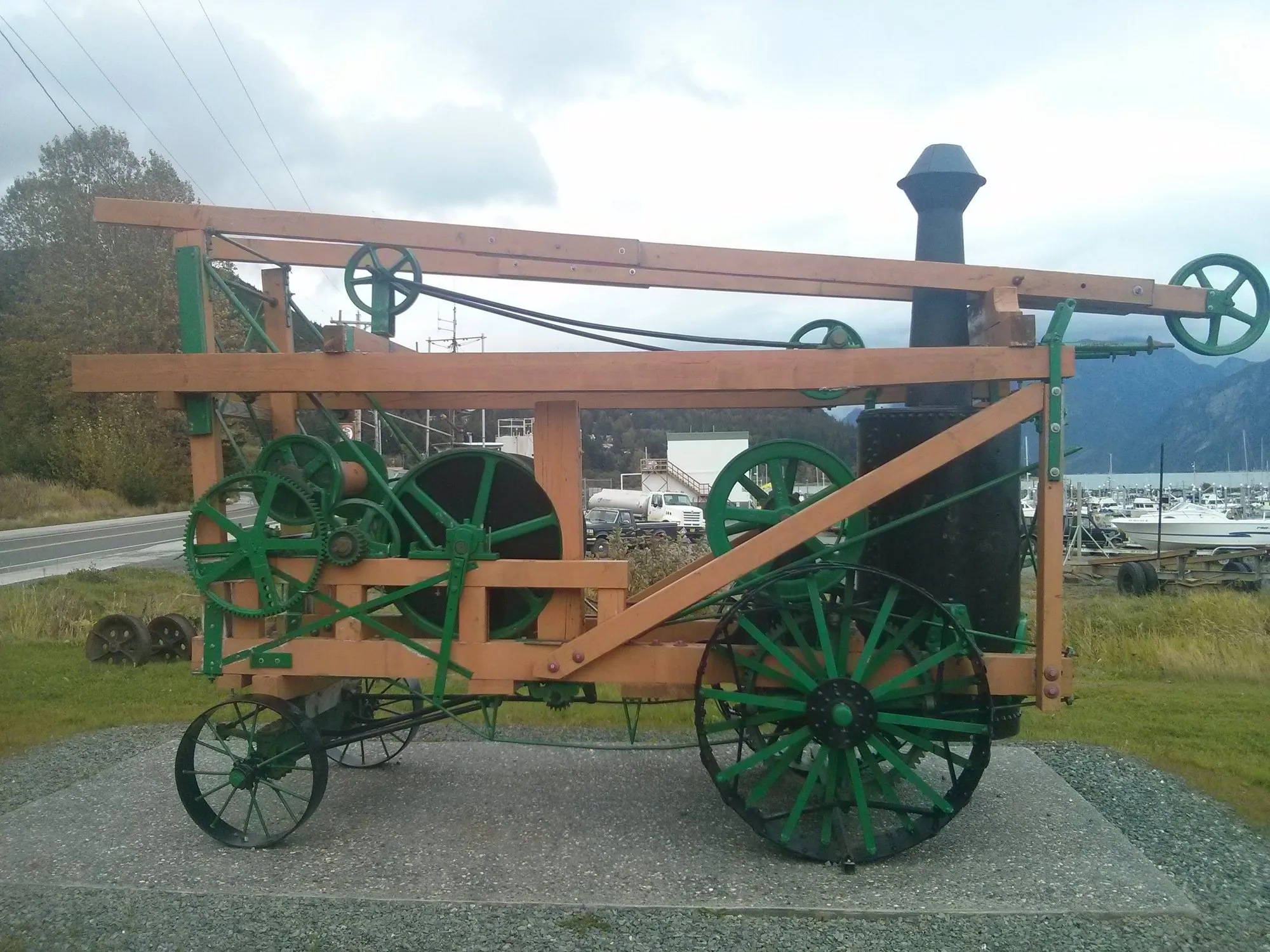
This steam-powered, portable drilling machine was used in the Chilkat Valley for gold prospecting in the early 1900s. It could be driven to the worksite under its own power, at two speeds of 2 and 5 miles per hour. The Keystone design was developed and patented in 1892 by Robert M. Downie and built by the Keystone Driller Company of Beaver Falls, Pennsylvania.
How a cable drill works
The drill bores a hole by repeatedly raising and dropping a hollow drilling tool. The cable runs from the main cable reel, through pulleys on a hinged beam, over the mast-head pulley and down the hole. A cam wheel raises and lowers the hinged beam, which produces the up-and-down motion of the tool. Earth brought up in the hollow tool was sampled for gold.
The sign at the site shows the drill at work at Dalton Cache, near 40 Mile on the Haines Highway, in 1937.