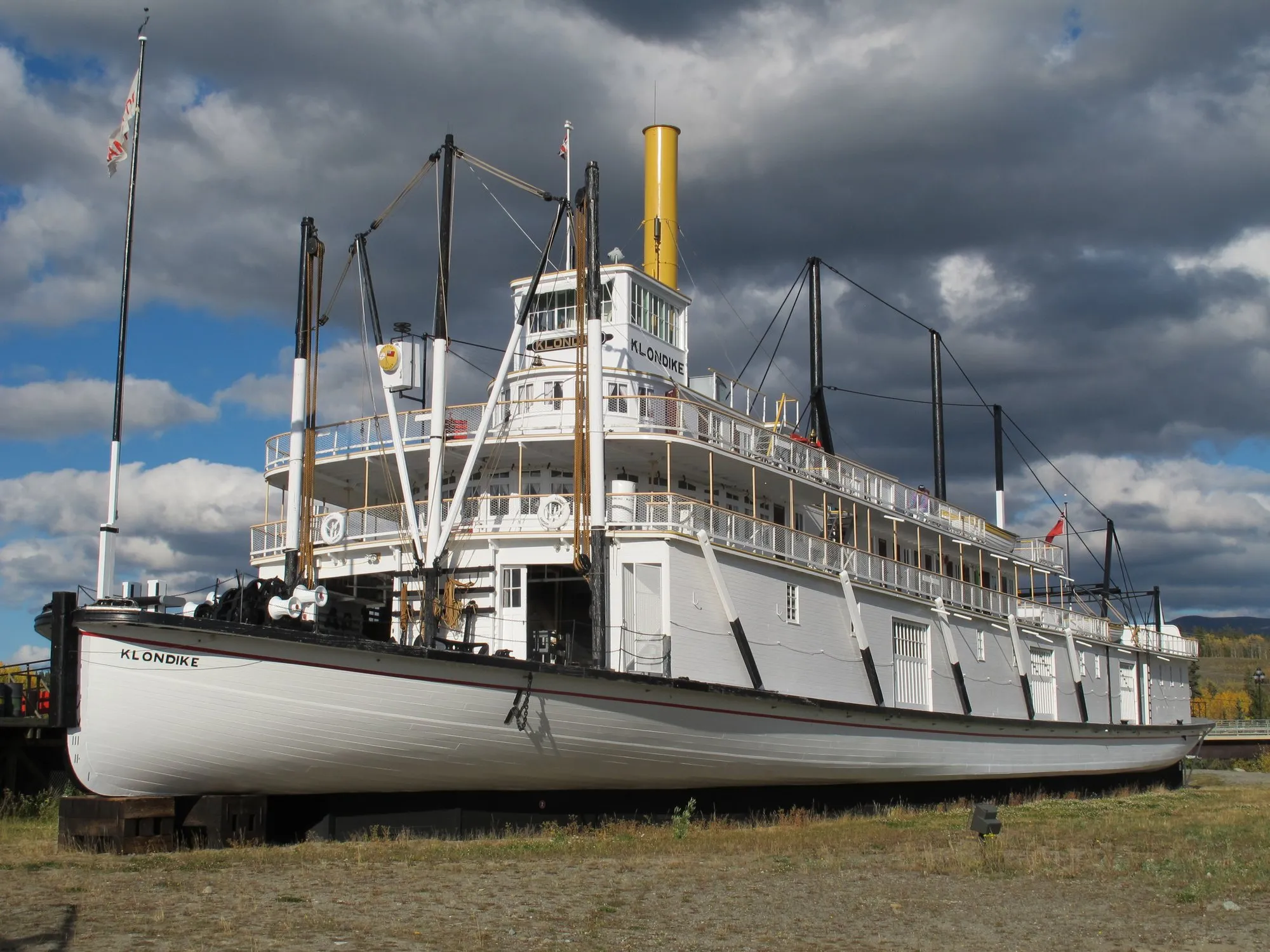
The Klondike on blocking beside the river at Whitehorse, white hull and decks, yellow stack, under dark clouds with autumn trees behind
Yukon · Built 1937

SS Klondike (II)

The second Klondike, a Yukon River freight sternwheeler of the British Yukon Navigation Co., now preserved at Whitehorse.

Above: The Klondike at Whitehorse, September 2011. Photo: by author.

Draft record. The particulars below have not yet been checked against primary sources and may change. Corrections are welcome.

The second Klondike replaced an earlier boat of the same name and worked the Yukon River between Whitehorse and Dawson City. She is preserved on the riverbank at Whitehorse.

History

The first Klondike was launched by the British Yukon Navigation Company in 1929. She was a breakthrough in sternwheeler design: her cargo capacity was about 50% greater than other boats on the river, with no loss of shallow draft. She was the first boat big enough to carry her cargo tonnage without pushing a barge. In 1936 she struck a reef and broke her back. The company immediately built the Klondike No. 2, which Parks Canada calls a virtual carbon copy of her predecessor.

For her first five years the new Klondike carried merchandise, supplies and a few passengers from Whitehorse to Dawson City. Downstream the run took about 36 hours, with one or two stops for wood. Beyond Dawson she went on to Stewart Landing to load silver-lead ore for Whitehorse. The upstream run against the current took four or five days. The ore trade stopped in 1941, when the territory’s largest silver-lead producer suspended operations, but traffic for the building of the Alaska Highway partly made up the loss. Ore production resumed in 1946. All-weather roads built in the early 1950s ended the sternwheelers’ role as freight carriers. The Klondike was refitted as a cruise ship, but the tourist trade was not yet big enough to support her. She ended her last run up the river at Whitehorse in August 1955.

Hull

Gregory Foster’s 2001 Hull Lines & General Profile records lines taken from the actual frames when the hull was opened up during the restoration that began in 2000. The work was led by head shipwright Wayne Loiselle. According to its notes:

  • The frames are spaced 16 in on centre.
  • The planking is 2½ in in the topsides and 3 in below and on the bottom, all of Douglas fir.
  • The hull is very low-sided and shoal, and needs multiple keelsons and chine trusses to hold its shape lengthwise.
  • Seven waterlines are marked on the original frames at one-foot intervals. This suggests the boat was lofted and built to a design that has not yet been found.
  • The forebody is finely modelled, the midsection flat and box-like, and the stern round in section.

The superstructure profile on the sheet follows J. R. Lisoway’s drawings of 1970–72.
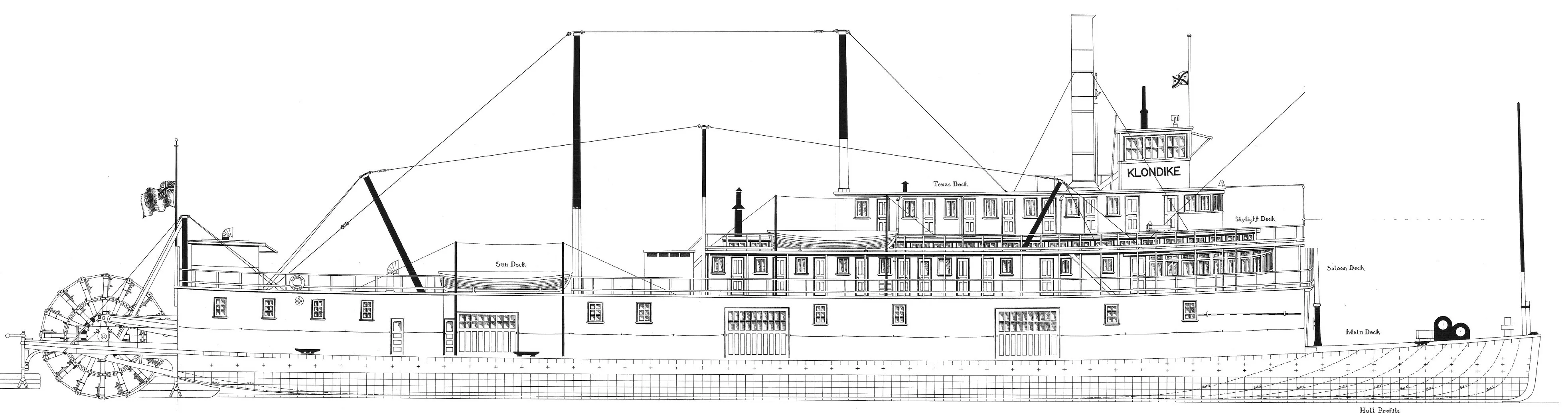
Elevation

Outboard profile of the Klondike from sternwheel to bow, three decks with stack and wheelhouse, deck names labelled
General profile by G. W. Foster, shipwright, 2001, from the Parks Canada Hull Lines & General Profile sheet · Vessel Drawings (11) →

Technical data

Boiler
TypeLocomotive (fire-tube)
MakerPolson Iron Works, Toronto
Built1901 (Parks Canada; ExploreNorth). Ingenium gives 1909.
Tubes242
Heating surfacenot yet recorded
Grate areanot yet recorded
FuelWood; converted to oil about 1952
Working pressure184 psi

Parks Canada says the boiler was used earlier in the Yukoner and the first Klondike.

Engines
TypeTwo tandem-compound condensing engines
MakerGillette & Eaton, Lake City, Minnesota
Built1929
High-pressure cylinder17 in
Low-pressure cylinder28 in
Stroke72 in (6 ft)
Power525 bhp at 16 rpm (71.5 NHP)
Valvesnot yet recorded
Valve linkagenot yet recorded
Valve motion fromnot yet recorded
Cut-off valvesnot yet recorded

Engines and boiler were taken from the first Klondike when the second was built.

Condenser
Condenser fittedYes
TypeJet condenser
Makernot yet recorded

Parks Canada describes the engines as 'compound jet-condenser type'.

Wheel
Diameter19 ft 4 in as built; 19 ft 10 in after a new wheel was fitted in 1947
Length (face)23 ft
Arms (spokes)16, spaced 22.5° (Parks Canada model drawing, sheet 4)
Flanges (wheels on shaft)5 (Parks Canada model drawing, sheet 4)
Buckets16
Bucket dimensionsnot yet recorded

Caretakers today

The Klondike (II) is cared for by the organizations below. Visit their sites for opening hours, tours and ways to support her preservation.

Sources

  1. Gregory W. Foster, shipwright, Hull Lines & General Profile, S.S. Klondike, Parks Canada National Historic Site, September 2001. Dimensions: hull (stem to transom) 211 ft 2 in; overall 239 ft 4 in; beam inside planking 41 ft 5½ in, over catwalks 43 ft 9½ in; overall height 60 ft 7 in; 1,363 tons. Notes on frames, planking and lines.
  2. Parks Canada, Model Drawing Collection: S.S. Klondike, sheet 1 (Elevations and Details): history text. Source for the History section.
  3. Parks Canada, Engineering and Architecture. Model Drawing Collection: S.S. Klondike, Yukon River stern wheeler. Cover and sheets 1–9. Undated.
  4. Parks Canada, S.S. Klondike National Historic Site, 'Specifications' (parks.canada.ca). Boiler, engine type, power and hull figures.
  5. ExploreNorth, 'Klondike (II)' (explorenorth.com/library/ships/klondike2.html). Engine maker, cylinders, stroke, boiler tubes and wheel.
  6. Ingenium, 'As the world (err) as the wheel turns…' (ingeniumcanada.org). Reuse of the first Klondike's machinery; oil conversion.