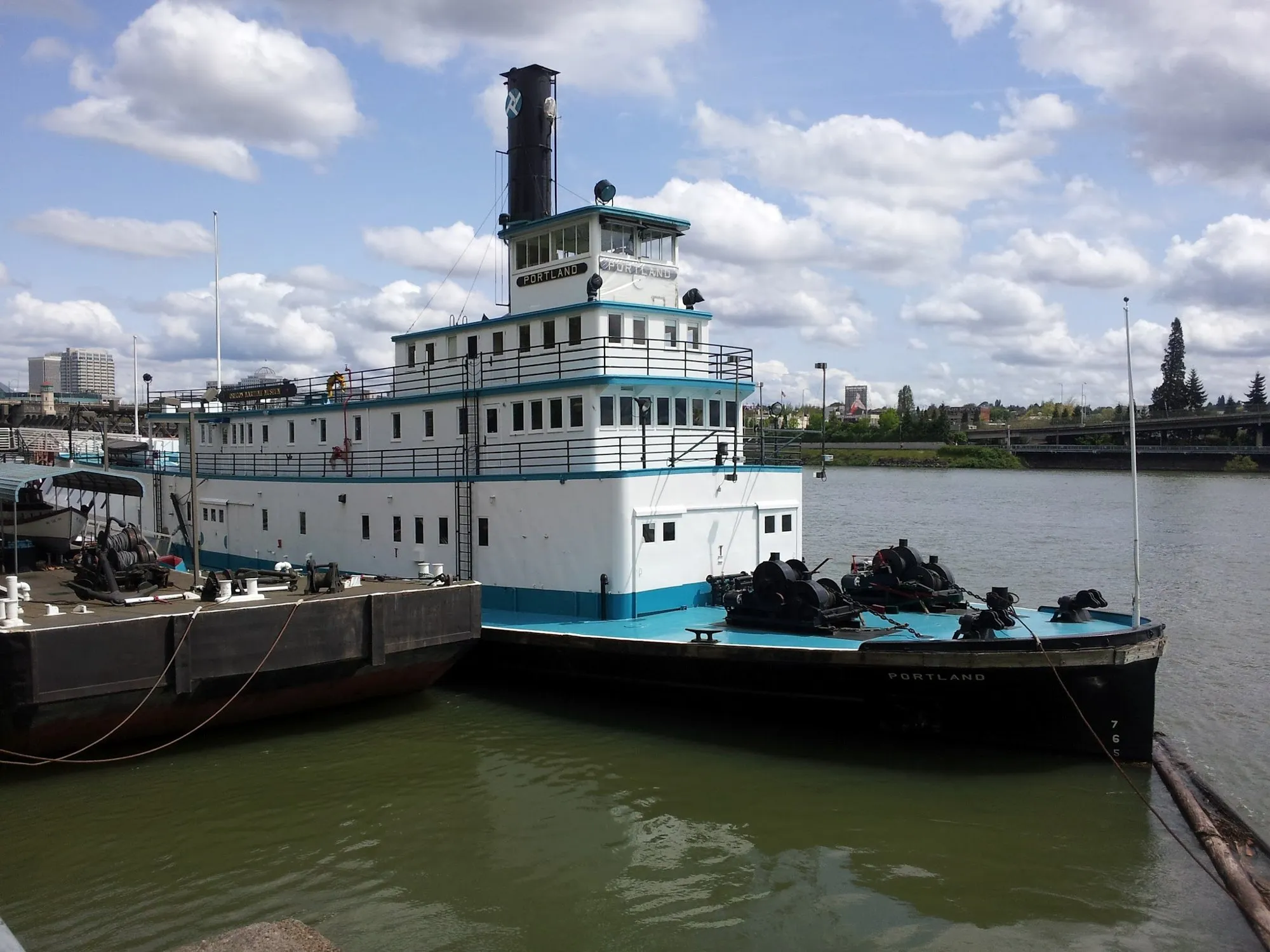
Steam sternwheel harbor tug built for the Port of Portland, preserved as a working museum vessel on the Willamette River.
Above: The Portland at the Oregon Maritime Museum, April 2012. Photo: by author.
Draft record. The particulars below have not yet been checked against primary sources and may change. Corrections are welcome.
Research for this page is under way.
About the drawings
The drawing set is by Edward K. Neubauer of Milwaukie, Oregon. Sheets 1 to 4 show the firstPortland, the Port of Portland’s sternwheel towboat of 1919, which worked until 1947. Neubauer drew them in 1970 from J. H. Johnston’s original blueprints of March 1918, lent by the Port of Portland, with photographs and comments from her builder, Albert Nelson, and from Capt. Homer Shaver, who ran her.
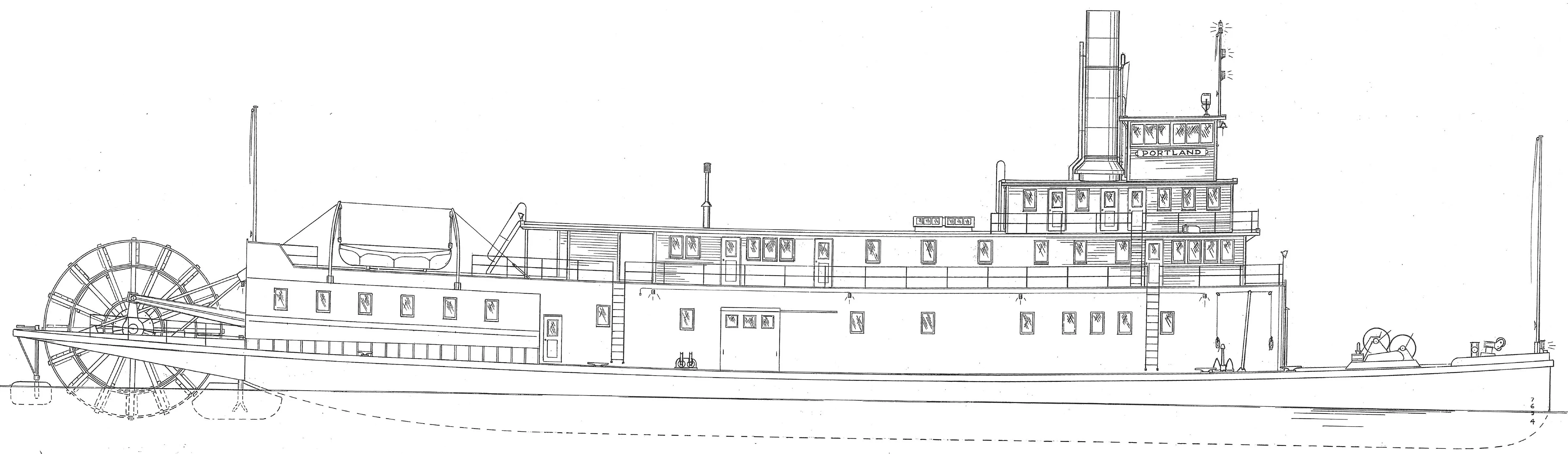
The cover sheet (1990) compares that boat with her 1947 replacement, the vessel preserved today. The elevation above is the 1947–81 profile from that sheet.
Elevation
Outboard profile of the 1947 Portland as she appeared 1947 to 1981, from Edward K. Neubauer's cover sheet · Vessel Drawings (5) →
Technical data
Boiler
Type
Water-tube
Maker
Babcock & Wilcox
Built
not yet recorded
Tubes
More than 500, 2 in diameter, arranged in a cube between front and back headers, with a steam drum above
Heating surface
not yet recorded
Grate area
not yet recorded
Fuel
Black bunker oil in service, heated so it would flow; diesel today. Three burners, with fuel atomized at about 150 psi
Working pressure
Safety valves set at 250 psi; designed working pressure 240 psi for the main engine and 150 psi for the auxiliaries
Rated at 1,000 hp each; the main engine placard says the hull was made long enough for two such boilers. Air for combustion comes from a steam-turbine fan at the boiler front. Feed water is city tap water stored in two 10,000-gal tanks, with river water as an emergency supply. Fuel capacity is about 35,000 gal on the boiler placard and 40,000 gal on the engine placard. From cold, an air compressor runs the fuel pump to 50 psi, and it takes about three hours to reach 240 psi.
Engines
Type
Double-acting, single-expansion (simple) engine with two horizontal cylinders, port and starboard; cranks at 90°
Maker
not yet recorded
Built
not yet recorded
High-pressure cylinder
26 in (one cylinder per engine)
Low-pressure cylinder
None (simple engines)
Stroke
108 in (9 ft)
Power
1,800 hp for both cylinders at full turns of 16 rpm (museum placard); the National Register form's summary gives 900 hp
Valves
Piston valves
Valve linkage
not yet recorded
Valve motion from
Eccentrics; the nomination says the valves are 'operated by eccentrics driven by the pitmans'
Cut-off valves
not yet recorded
At full power there are 62 tons of push and pull on each side. Pitmans of welded steel, 36 ft long, drive cranks on each side of the wheel. Steam also works a two-cylinder drum steering engine and the feed-water and fuel-oil pumps.
Condenser
Condenser fitted
not yet recorded
Type
not yet recorded
Maker
not yet recorded
Not mentioned in the National Register nomination.
Wheel
Diameter
25 ft
Length (face)
26 ft
Arms (spokes)
not yet recorded
Flanges (wheels on shaft)
5 (five wheel hubs on a forged steel crankshaft 30 ft long)
Buckets
20
Bucket dimensions
3 ft wide
Wooden wheel.
Caretakers today
The Portland is cared for by the organizations below. Visit their sites for opening hours, tours and ways to support her preservation.
Oregon Maritime Museum, interpretive placards aboard the Portland: Boiler, and Main Engine, Starboard Cylinder. Photographed by the author, April 29, 2012 (IMG_20120429_131931, IMG_20120429_133423).
Harold L. Englet (Oregon Maritime Center and Museum), National Register of Historic Places Registration Form, Steam Tug PORTLAND, February 15, 1997. Source for the machinery and wheel data.
 Sternwheeler.org